An Early Arrival, Before the Ground Fills
An early stadium arrival lets you notice the approach, entry thresholds and first matchday sounds before crowds turn the ground into a single rush.
An early stadium arrival reveals how a ground changes before the crowd becomes its main event. The approach, the entrance and the first sounds inside each offer clues about how the place prepares people for matchday. Give yourself time to notice them, without turning the visit into a field inspection with a clipboard and a strained expression.
This is a simple route of attention: begin outside, cross the threshold, then watch activity gather. You do not need special access or a particular seat. Stay in public areas, follow staff directions and let the ordinary details set the pace.
What can you notice on the approach?
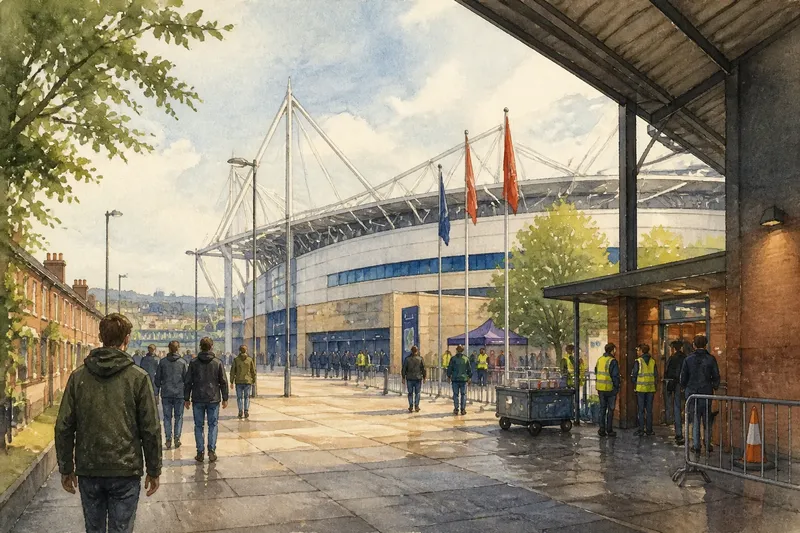
Start far enough away to see the stadium in context. From a public street or plaza, look at what guides you toward it: a roofline visible over nearby buildings, a change in paving, signs, flags, barriers or a widening stream of people. These features form a loose invitation rather than a single instruction. Some visitors arrive from transit; others approach from parking, local shops or residential streets. The ground meets each route differently.
Notice which parts of the building appear first. A roof may be visible long before the entrances, while a blank outer wall can make the venue feel distant until the street opens up. Trees, bridges and neighboring structures may frame or interrupt the view. The point is not to rank the architecture. It is to see how the stadium becomes present in stages.
Pay attention to the pace of the surroundings. A quiet side street may lead to a busy forecourt, or a broad pedestrian route may keep people moving without an obvious bottleneck. Look for where people pause: beside a meeting point, near a sign, at a food stand, or at the edge of a plaza to take in the building. These pauses are part of arrival too.
Imagine arriving on a calm afternoon when a row of vendor shutters is still down and a tall stand is visible above the street. As you walk closer, staff begin setting out signs and a few groups gather by a familiar corner. You can observe how the route shifts from everyday street to matchday destination without assuming that the same sequence will suit every visitor.
Where does the ground begin?
There is rarely one neat line between the city and the stadium. The change may start at a plaza, a perimeter fence, a ticket check or a covered entrance. Notice where the surroundings begin to feel managed for an event: temporary barriers direct the flow, staff become easier to spot, or signs replace the shopfronts and street names that brought you this far.
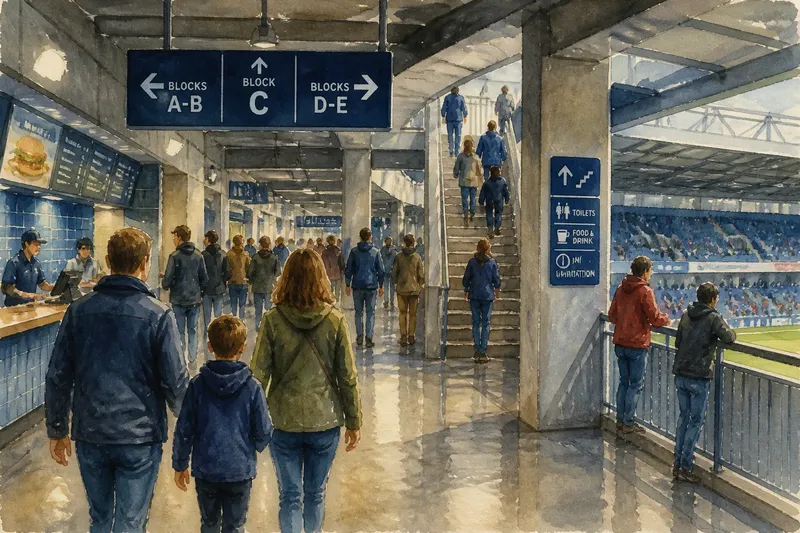
At the threshold, look at how the space communicates what happens next. Are entrances clearly distinguished? Can you tell where to queue, where to keep moving and where to ask for help? Watch how people read the signs. A sign that is easy to miss from one direction may be plain from another; an entrance can look obvious once you know it is there. Avoid blocking a route while you study it. The moving crowd is not a display laid on for visitors.
Notice the change in light and sound as you pass under a canopy or through an enclosed entry area. Daylight may narrow to a bright opening ahead; footsteps can become sharper against a hard floor; voices may gather in a sheltered space. These shifts make the threshold feel like a transition even when the materials are simple.
Some grounds make this passage gradual, with open space and several small decisions. Others bring visitors quickly to a controlled entrance. Neither arrangement tells the whole story on its own. A gradual approach can feel welcoming but leave people uncertain about where to go; a direct entry can be legible while offering little room to pause. Notice the experience you actually encounter rather than assigning the building a score.
How does the light change inside?
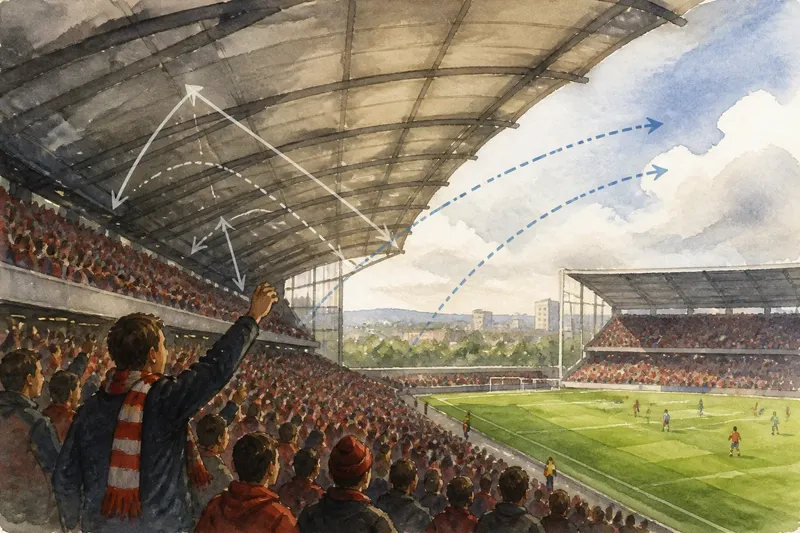
Once inside, pause in a place where stopping is permitted and look toward the brighter and darker parts of the route. A concourse opening may frame the field, while a roof edge cuts sunlight across a wall or floor. Under a covered stand, daylight can arrive from the sides and leave the seating bowl in a softer, more even shade. The effect depends on the weather, the orientation of the ground and the surrounding structures.
Watch how surfaces respond. Pale paving may carry reflected light into a sheltered passage; dark cladding can make a doorway feel subdued until the eye adjusts. Glass may show the sky and the structure at once, while a fabric banner can soften a hard boundary. These details are easiest to notice before people and signs fill every view, but the ground is never entirely still: staff may be preparing gates, cleaning or arranging equipment.
Do not treat the brightest view as automatically the best one. A sunlit opening may be attractive but difficult to look toward for long, while a shaded route can feel calmer and easier to read. A brief glance at where light falls is enough; there is no need to chase the sun around the stadium or infer how every seat will feel later.
What are the first signs of matchday?
Listen for activity arriving in layers. The earliest sounds may be a service cart, a radio, a gate being checked or a short exchange between staff. Later come the small clusters of conversation, the calls of vendors and the first louder reactions from people who have spotted friends. These are not yet the unified roar associated with play. They are separate signals that the place is waking up.
Look for work that usually goes unnoticed once the stands are busy. Staff may be checking signs, preparing counters, opening a route or answering questions. Supporters may compare tickets, adjust scarves or settle on a meeting place. Children often look upward at the stands or toward the field, while adults check entrances and scan for familiar faces. The ground’s early rhythm is made of practical tasks as much as anticipation.
Notice where activity gathers and where it has not reached yet. One entrance may be active while another remains quiet; a concourse can carry the first hum while a nearby seating section stays empty. Matchday atmosphere does not arrive as one switch being thrown. It spreads unevenly, shaped by access points, staff routines and the habits of people arriving together.
What should you look for before leaving the route?
Use a few simple prompts to keep the visit attentive without making it laborious:
- Approach: Which street, path or landmark first makes the stadium easy to recognize?
- Orientation: What signs or sightlines help you understand where the entrances are?
- Threshold: Where does the walk begin to feel like entry into an event rather than ordinary street movement?
- Light: Which openings, roof edges or surfaces change the brightness of the route?
- Sound: What is the first matchday sound you can distinguish, and where does it come from?
- Activity: Which jobs or small rituals appear before the stands fill?
Choose one or two observations that interest you; collecting every detail is not the point. It is not worth lingering beside an entrance to watch queues form, or trying to identify every sound in a busy concourse. Those efforts add little and can get in the way of people doing the practical business of arriving.
What do people ask about an early stadium arrival?
How early should I arrive at a stadium?
Allow enough time to reach your entrance without rushing, using the venue’s current guidance for entry and any checks. If you want to observe the approach, add a little unstructured time before heading to your seat, rather than relying on a fixed amount that may not suit the event or route.
Can I walk around the stadium before gates open?
Public access varies by venue and event, so stay on open streets and permitted public areas until entry is allowed. Do not cross barriers, follow service routes or assume that an open-looking gate is an invitation.
What should I bring for an early visit?
Bring the items you need for the event, such as your ticket and a weather-appropriate layer, and check the venue’s entry rules before setting out. A phone can help with directions, but you do not need equipment to notice light, sound and movement.
Is an early arrival useful if I already know the ground?
Yes, if you are curious about how the place changes from an ordinary exterior into a matchday setting. Familiar routes still acquire new signs, staff routines and patterns of light, though you can skip the observation and simply head in if that suits you.
When does the early visit feel complete?
It is complete when you have noticed a transition, not when you have inspected every corridor. Perhaps you have seen the stadium emerge above the neighborhood, followed a sign toward the entrance, or heard the first separate conversations gather into a broader murmur. Those details offer a useful picture of how the ground receives people before its central event begins.
An early stadium arrival is most revealing when it leaves room for the unexpected. A closed stand, a different entrance or a sudden change in weather can alter the scene. Follow the route that is open, make space for others and carry one small observation with you: the moment the city’s ordinary sounds give way to the ground’s first matchday signals.