The Perfect View Myth: What a Stadium Seat Cannot Show
Stadium sightlines shape what you notice, from player spacing to overlapping movement. Learn how perspective affects attention and how to choose a view that suits you.
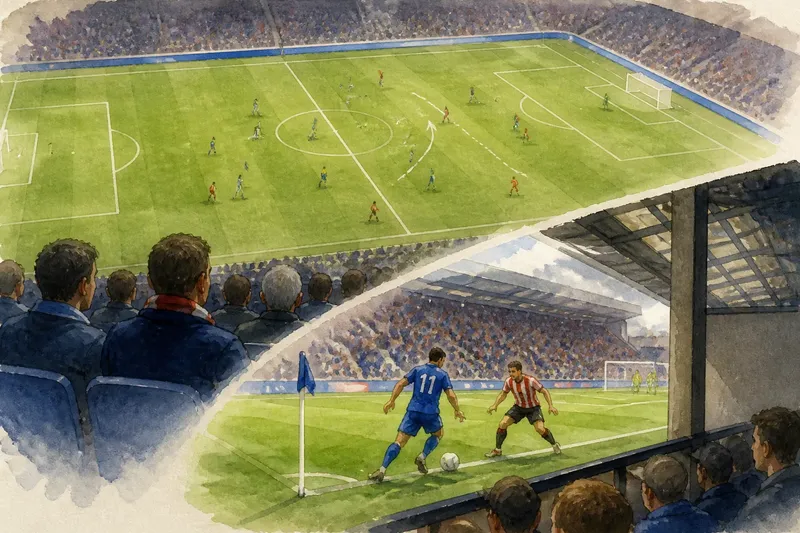
Stadium sightlines can make a match look orderly while hiding the movement that created the opening. A seat’s distance and height change which relationships are easy to read, so seeing the whole field is not the same as seeing every important action.
What does distance make easier to read?
From higher in the stands, players appear smaller, but their positions relative to one another are easier to compare. You may see a defensive line shift or a gap open between midfield and defense. From a lower seat, nearby bodies and the apparent depth of the field can make that larger arrangement harder to assemble.
Closer to the pitch, a player’s body orientation, first touch, or short exchange may be more distinct. The wider pattern can be less obvious because near-side action claims more of your attention. Neither view is neutral: one emphasizes relationships across the field, the other the detail of a local contest.
How can perspective conceal movement?
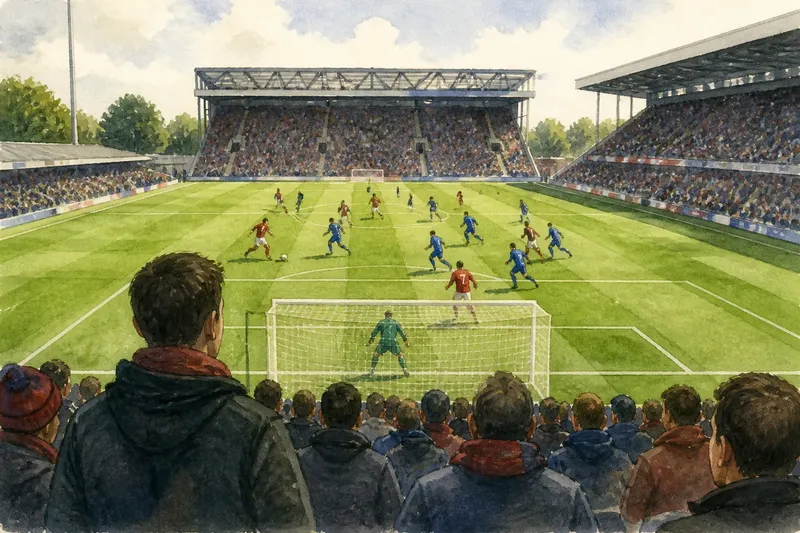
At the far end, depth appears compressed. Players can seem closer together, and a diagonal pass may look more like a lateral one. That makes it harder to judge the space an attacker has to turn or how quickly a defender is closing.
Bodies also overlap. A player may disappear behind an opponent, referee, or cluster around the ball, then reappear after the useful moment has passed. A clear patch of turf is not proof that every player on it is easy to distinguish.
When individual touches become hard to follow, look at the surrounding arrangement. You may still be able to read a team’s shape even if the ball’s exact path is obscured.
Why does the ball not tell the whole story?
A clear view of the ball does not show every cause of the play. A runner can start before a pass, a defender can step forward, or a teammate can draw a marker away. Those movements may happen outside the area where most spectators are looking.
A broad view makes more of the field available, but attention still has limits. Follow the ball and you may miss a runner on the far side; scan the defensive line and you may miss a close touch. During a pause, widen your gaze and watch a line of defenders for a forward moving between them. That offers a different view of the same passage, not a correct way to watch.
What does a low angle change?
From a lower angle, players can seem larger and nearer, while bodies and advertising boards may obscure the far boundary. A close contest can feel vivid, but a nearby player may hide a teammate or the passing lane between them.
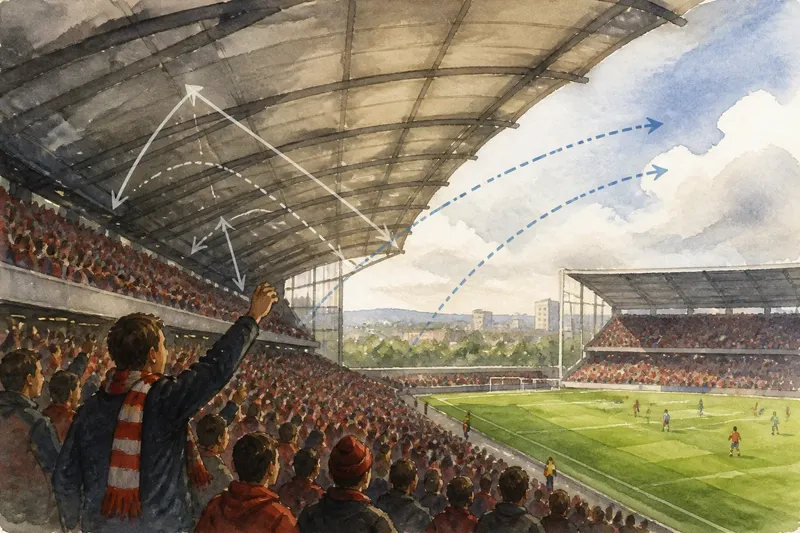
From higher up, the grass between players is easier to see. Yet a visible lane does not tell you how quickly a defender can close it, and the greater view can flatten apparent distance. A lifted ball may also be difficult to track against a busy background. The effect depends on the stand and what sits behind the field.
How does perspective affect the sense of timing?
A distant view can make a sequence easier to read as a pattern: a line advances, a runner starts, and the ball travels into space. From closer in, the sequence may resolve into a glance over the shoulder or a defender changing stance. Both views reveal timing, but neither reveals every part of it.
Direction alters apparent speed, too. A player running toward your position may seem to approach quickly, while someone moving laterally at the far end may appear slower. Distance and angle shape the impression alongside the movement itself.
Imagine you are seated high behind the halfway line and want to understand how a team creates space. You notice a forward draw one defender aside, then a second attacker move into the gap. If you instead begin from a hypothetical lower seat near a corner, you may focus on the ball carrier’s touch and the defender blocking the route. The first view emphasizes the arrangement; the second, the immediate contest.
When is a broad view less useful?
A view that covers most of the field can invite constant scanning. The eye has to travel, refocus, and locate the ball again as play changes direction. More territory in view does not automatically make watching easier; sometimes it turns a match into a modest clerical task.
No position keeps every phase equally legible. A touchline seat may make near-side play prominent, while movement farther away is harder to pick out. A seat behind a goal may emphasize action toward that end, with detail at the opposite end less distinct.
It is not worth pursuing a seat that promises a complete account of every action. Instead, decide which detail you would most regret losing: overall team shape, close technical play, or movement around one area of the field.
How can you compare stadium sightlines before choosing?
Use a seating plan to locate a section and establish its orientation. Then look for a seat-view image from the same level and side; treat it as a guide, not a full preview. Check what an obstruction actually covers. A blocked patch of turf, a goal, and movement near the touchline are different limitations.
Say you are choosing between two hypothetical seats for watching how attacks develop. The starting information is a seating chart showing one seat high behind the halfway line and another lower near a corner, plus images that show the far goal partly screened from the corner seat. First, compare the images for which parts of the field are visually clear. Next, decide that team shape matters more to you than close-up detail. The halfway-line seat then better fits that preference; if seeing nearby touches matters more, the lower seat may be the better trade, despite the screened far goal. The result is a choice based on a stated priority, not a claim that either seat shows everything.
- Check whether the seat-view image comes from the same section and level; if it does, use it to compare perspective, and if it does not, treat it only as general orientation.
- Check whether the far goal is visible; if it is, keep the seat in consideration for following action there, and if it is obscured, choose another view if that area matters to you.
- Check for barriers or nearby structures in the sightline; if they cover a part of play you value, rule out the seat, and if they affect only an unimportant area, weigh the remaining view.
- Check how much of the far side appears distinct in available images; if players and boundaries remain easy to separate, consider the seat for broad viewing, and if they overlap, favor a closer view when local detail matters.
- Check whether near-side bodies dominate the image; if they do, choose that section for close action only if that is your preference, and otherwise compare a higher or more central view.
- Check the venue’s description of any partial-view restriction; if it identifies the exact area you want to watch, choose another seat, and if the restriction is elsewhere, decide whether the trade suits your priorities.
What do spectators ask about stadium sightlines?
Does a higher seat make it easier to follow a match?
A higher seat can make team shape and movement across the field easier to compare. It can also make individual touches and far-end action feel distant, so height is a preference rather than a rule.
Can a seating chart show exactly what I will see?
A chart shows location and orientation, but not fully how perspective or overlapping bodies will affect the view. Use it to narrow options, then look for an image from a comparable section and level.
Why can players seem crowded together at the far end?
Perspective compresses apparent depth, making distances harder to judge. Players can also overlap visually, so the spacing on the field may be clearer than it looks from the stand.
What should I prioritize if part of the field is hard to see?
Decide which action matters most to you, such as close control, movement away from the ball, or team shape. Avoid a view whose obstruction covers that area, even if the rest of the field appears clear.
What makes a view useful rather than perfect?
A stadium seat is useful when its perspective helps you notice the parts of a match you care about. Distance can reveal shape while softening detail; a lower angle can bring a contest close while concealing movement behind it. Every seat edits the scene.
For stadium sightlines, compare what each position makes distinct and what it leaves difficult to resolve. Choose the tradeoff that fits how you watch, and remember that a view is one part of matchday, not a promise to explain every passage of play.