Why a Stadium Roof Can Hold a Crowd’s Sound
Stadium roof acoustics depend on shape, materials and open edges, helping explain why some grounds make chants feel close while others let sound disperse.
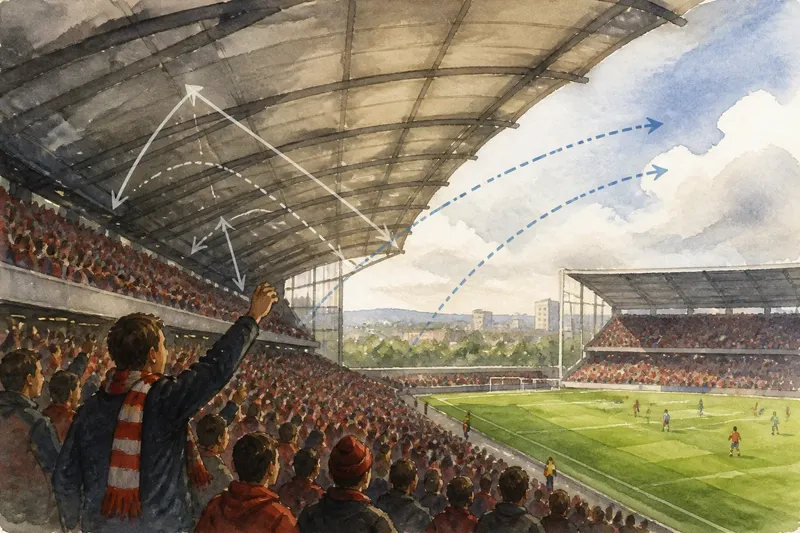
A stadium roof can make a chant feel close without making the crowd louder. Stadium roof acoustics depend on where sound travels, what it meets and how much of the ground remains open to the sky. A roof is not a lid fitted over a bowl; it is one part of a space with many paths for sound to take.
That distinction explains why two covered grounds can feel entirely different. One may return a crowd’s voices toward the seats, while another sends much of the sound upward or out through broad openings. The result is not determined by roof material alone, and there is no single acoustic recipe for a lively matchday.
What does a roof do to crowd sound?
People produce sound in many places at once: from rows of seats, aisles, concourses and sometimes the pitch. Without overhead cover, much of the sound travels upward and continues into open air. A roof intercepts some of those sound waves and reflects them back into the stadium.
Those reflections can make voices more present to listeners beneath the canopy. But a reflection is not a recording played back at the audience. Sound loses energy as it travels, and its path matters: a wave reflected toward a stand may reach spectators there, while one reflected toward an opening may escape.
The roof also changes the sense of enclosure. When the canopy is low or extends far over the seats, spectators may feel that the space above them belongs to the crowd. A high, shallow canopy can give a different impression, even if both roofs cover a similar part of the seating. What people hear is bound up with what the architecture seems to contain.
Which surfaces return sound, and which absorb it?
Hard, smooth surfaces tend to reflect more sound than soft, porous ones. Metal panels, concrete and some solid cladding can send sound back into the bowl. Acoustic panels, perforated linings with absorptive backing and some fabric-like materials can reduce the amount reflected.
That does not make a reflective finish automatically better for spectators. A strong reflection can add presence, but repeated reflections may blur speech or make a chant harder to follow. Absorption can reduce that blur, though too much can make a covered area feel less acoustically connected to the crowd around it.
Designers may use different finishes in different places. A canopy could have a relatively reflective underside over seats and more absorptive treatment near a wall where sound would otherwise linger. The aim is not simply to send every voice back at maximum force. It is to shape reflections so they support a usable, coherent sound rather than a wash of competing echoes.
Material labels do not tell the whole story. Panel shape, joints, backing, surface texture and the angle at which sound meets a surface all affect what happens. Where a decision depends on product specifications, manufacturer instructions or local requirements, those should guide the choice.
Why do open edges matter?
A stadium with a roof is still open in important directions. The gap between canopy and pitch, exposed ends of a stand, and spaces between separate stands can all let sound pass out. These openings help distinguish a roofed grandstand from an enclosed arena.
Open edges can make sound seem less contained, but they can also prevent unwanted buildup. A roof that spans a stand and turns down along its edge may direct some reflections toward the seats. A canopy that stops well short of the pitch may leave more of the sound’s route upward unobstructed. Neither arrangement is inherently successful or unsuccessful; the effect depends on the whole geometry.
Nearby stands matter, too. A chant can travel across the pitch, meet an opposite stand and return as a later reflection. If the stands face one another across a relatively open field, that exchange may feel distinct from the more blended sound inside a continuous bowl. Corners, gaps and changes in roof height alter those routes, sometimes making one section seem acoustically separate from the next.
Why can the same chant sound different around the ground?
Listeners do not occupy a single acoustic position. A seat beneath a deep canopy may receive a strong reflection from overhead, while a seat near the roof edge hears more direct sound and more sound escaping into open air. A lower row may be partly shielded by people in front; an upper row may have a clearer route to the canopy.
Distance and direction matter as well. Voices from a nearby section arrive before voices from the far end, and the timing difference can make a large crowd sound layered rather than unified. A roof may strengthen some of those layers without erasing them. The audible character of a stand is therefore not a property of the roof in isolation.
Say a fictional ground has a steep home stand with a low canopy over its upper rows and an open end behind the goal. If supporters in the covered section start a chant, nearby spectators might hear a clear reflection from the canopy, while some sound from the open end disperses beyond the stand. The expected impression is a chant that feels concentrated in one area but does not fill the whole ground evenly. Change the roof angle or close the end, and the balance could shift.
It is not worth trying to judge a roof from a single dramatic moment on a broadcast. Microphones, commentary positions and audio mixing can emphasize one part of a ground and suppress another. The architecture can be considered directly, but a broadcast is an edited listening position, not a neutral acoustic map.
How does roof shape affect the sound?
A roof’s underside can be flat, curved, stepped or made of angled sections. Each shape sends reflections along different paths. A broad, gently sloping surface may direct sound toward parts of the seating; a curved surface can focus sound in some locations and leave others with less direct reflection. Small changes in angle can matter because they redirect the wave rather than merely changing how much is reflected.
Roof depth is another influence. A canopy reaching far over the seats can shield more of the stand from open sky and offer a larger surface for reflection. A narrow canopy may cover the top rows while leaving much of the lower seating open to the pitch and sky. Coverage can be designed for weather, sightlines, structure and acoustics at once, so acoustic effect is only one part of the decision.
The space behind the seats can also shape what listeners hear. A solid rear wall may return sound toward the bowl; a more open rear edge may allow it to disperse. Concourse openings and changes in the stand profile introduce further routes. A stadium is a collection of linked spaces, not one uniform chamber.
What questions help explain a stadium’s sound?
Does a closed roof always make a crowd sound louder?
No. Closing a movable roof changes the space, but the result depends on its shape, surface and remaining openings. It may make voices feel more enclosed without increasing sound equally at every seat.
Do metal roofs make the best atmosphere?
Metal can provide a reflective surface, but its performance depends on its form and what lies behind or below it. A reflective roof may return useful sound in one part of a stand and contribute to muddiness in another.
Why do chants sometimes seem to echo?
Several surfaces can return the same sound along routes of different lengths. Those arrivals may be heard as separate echoes or blend into a less distinct reverberant sound, depending on their timing and strength.
Can a roof make one stand sound louder than another?
It can contribute to that impression when one stand has more reflective cover or a more enclosed shape. Crowd size, location, distance and the activity of neighboring sections also influence what a listener perceives.
What should a spectator notice on arrival?
Look at how far the canopy reaches over the seats, whether its underside is smooth or visibly lined, and where the roof ends leave open gaps. Notice whether the rear of the stand is closed by a wall or opened onto concourses. These details suggest possible sound paths, though they cannot predict the exact experience from every seat.
Then listen for differences within the ground. A chant may have a clear direct voice in one area and a softer reflected presence elsewhere. The useful question is not whether the stadium is loud, but where its architecture keeps sound, where it lets sound go and how those routes help separate voices become a shared event.
Stadium roof acoustics are best understood as a relationship among canopy, openings, stands and listeners. A roof can help crowd sound feel held, but the effect comes from its particular arrangement of surfaces and edges. The next time a chant gathers, notice not only who begins it, but which parts of the ground seem to send it back.